How CASParser Cut 60-Minute Metering Lag to Near Real-Time and Unlocked SLG + PLG with Flexprice
How CASParser Cut 60-Minute Metering Lag to Near Real-Time and Unlocked SLG + PLG with Flexprice
Live Dashboard
for all customers
Annual Cost Savings
SLG + PLG
model adoption
Data Interportability
Near 0
Metering Latency
Faster Pricing Iteration

Company
Industry
Wealth-tech / Fintech Infrastructure
Size
Early-Stage
Customers
Wealth-tech platforms & Fintech Apps
The Challenge
As CAS Parser's customer mix shifted from a handful of enterprises to dozens of self-serve developers in the agent era, the existing AWS API Gateway-based metering layer couldn't keep up. Quota updates lagged 15-30 minutes for large accounts, usage events couldn't be exposed to customers, and subscription periods were locked to monthly or annual.
The Solution
A real-time metering and entitlements layer that updates quotas instantly, exposes usage events directly to customers, supports flexible plan structures including unlimited tiers, and was rolled out end-to-end in two developer days.
Company
Industry
Wealth-tech / Fintech Infrastructure
Size
Early-Stage
Customers
Wealth-tech platforms & Fintech Apps

"It just magically works behind the scenes. There's almost negligible lag around updation of the quotas."
Sameer Kumar, Founder
CAS Parser helps Wealth-tech and fintech companies build their portfolio-import workflows by parsing CAS (Consolidated Account Statement) PDFs from depositories and registrars including CDSL, NSDL, CAMS, and KFintech.
Customers range from wealth-tech platforms and fintech apps to mutual fund distributors and stock brokers building their own software.
Founded in 2020, CAS Parser has spent the last few years adapting to a rapidly changing customer base.
What used to be an enterprise-heavy revenue mix has flipped, as LLM-powered agents pushed down the cost of building software, the long tail of small dev shops and individual builders signing up for API access started growing faster than enterprise demand.
That shift forced a billing rethink.
CAS Parser helps Wealth-tech and fintech companies build their portfolio-import workflows by parsing CAS (Consolidated Account Statement) PDFs from depositories and registrars including CDSL, NSDL, CAMS, and KFintech.
Customers range from wealth-tech platforms and fintech apps to mutual fund distributors and stock brokers building their own software.
Founded in 2020, CAS Parser has spent the last few years adapting to a rapidly changing customer base.
What used to be an enterprise-heavy revenue mix has flipped, as LLM-powered agents pushed down the cost of building software, the long tail of small dev shops and individual builders signing up for API access started growing faster than enterprise demand.
That shift forced a billing rethink.
CAS Parser helps Wealth-tech and fintech companies build their portfolio-import workflows by parsing CAS (Consolidated Account Statement) PDFs from depositories and registrars including CDSL, NSDL, CAMS, and KFintech.
Customers range from wealth-tech platforms and fintech apps to mutual fund distributors and stock brokers building their own software.
Founded in 2020, CAS Parser has spent the last few years adapting to a rapidly changing customer base.
What used to be an enterprise-heavy revenue mix has flipped, as LLM-powered agents pushed down the cost of building software, the long tail of small dev shops and individual builders signing up for API access started growing faster than enterprise demand.
That shift forced a billing rethink.

Start Building for Free
Get started with our open-source platform
The initial issue of metering on AWS API gateway
Before Flexprice, CAS Parser ran metering through AWS API Gateway's usage plans feature. It worked, for a while.
"That went fine for quite a bit. But the moment the cost to develop new software became cheaper, we saw a lot of customers (small software shops or individuals) coming to us asking for API access. The current system had limitations."
The cracks showed in three places.
Quota updates lagged 15-30 minutes for large accounts. For a customer with 30,000 credits, the dashboard simply wouldn't reflect actual consumption in any reasonable window. New customers would call an endpoint via Postman, see the API succeed, then watch their usage dashboard sit frozen for a quarter of an hour. Hardly the polished onboarding moment a paid API platform needs.
Subscription periods were rigid. Usage plans only supported monthly and annual cycles. Per-customer flexibility on billing windows or custom plan periods wasn't practical to model.
Usage events couldn't be exposed to customers. API Gateway didn't store the kind of metadata, logs, and event-level detail that would let CAS Parser show customers exactly what they'd consumed and when. Customers had to trust the invoice.
"It was a Friday. One of their product team members reported that the dashboard didn't update for more than 15 minutes. On Monday, we were going to go live with Flexprice, and that problem automatically got solved by Monday because we just switched the systems behind the scenes."
Before Flexprice, CAS Parser ran metering through AWS API Gateway's usage plans feature. It worked, for a while.
"That went fine for quite a bit. But the moment the cost to develop new software became cheaper, we saw a lot of customers (small software shops or individuals) coming to us asking for API access. The current system had limitations."
The cracks showed in three places.
Quota updates lagged 15-30 minutes for large accounts. For a customer with 30,000 credits, the dashboard simply wouldn't reflect actual consumption in any reasonable window. New customers would call an endpoint via Postman, see the API succeed, then watch their usage dashboard sit frozen for a quarter of an hour. Hardly the polished onboarding moment a paid API platform needs.
Subscription periods were rigid. Usage plans only supported monthly and annual cycles. Per-customer flexibility on billing windows or custom plan periods wasn't practical to model.
Usage events couldn't be exposed to customers. API Gateway didn't store the kind of metadata, logs, and event-level detail that would let CAS Parser show customers exactly what they'd consumed and when. Customers had to trust the invoice.
"It was a Friday. One of their product team members reported that the dashboard didn't update for more than 15 minutes. On Monday, we were going to go live with Flexprice, and that problem automatically got solved by Monday because we just switched the systems behind the scenes."
Before Flexprice, CAS Parser ran metering through AWS API Gateway's usage plans feature. It worked, for a while.
"That went fine for quite a bit. But the moment the cost to develop new software became cheaper, we saw a lot of customers (small software shops or individuals) coming to us asking for API access. The current system had limitations."
The cracks showed in three places.
Quota updates lagged 15-30 minutes for large accounts. For a customer with 30,000 credits, the dashboard simply wouldn't reflect actual consumption in any reasonable window. New customers would call an endpoint via Postman, see the API succeed, then watch their usage dashboard sit frozen for a quarter of an hour. Hardly the polished onboarding moment a paid API platform needs.
Subscription periods were rigid. Usage plans only supported monthly and annual cycles. Per-customer flexibility on billing windows or custom plan periods wasn't practical to model.
Usage events couldn't be exposed to customers. API Gateway didn't store the kind of metadata, logs, and event-level detail that would let CAS Parser show customers exactly what they'd consumed and when. Customers had to trust the invoice.
"It was a Friday. One of their product team members reported that the dashboard didn't update for more than 15 minutes. On Monday, we were going to go live with Flexprice, and that problem automatically got solved by Monday because we just switched the systems behind the scenes."
Real time usage metering without any lag
Developer-First APIs with usage events as a first class object
Operability for a Lean Team
Why CASParser Chose Flexprice?
Why CASParser Chose Flexprice?
1. Real time usage metering without any lag
The single biggest unlock. Where the previous stack lagged 15-30 minutes on high-credit accounts, Flexprice updates quotas instantly.
For a usage-based product where customers compare their dashboard against their own API calls in real time, the difference isn't cosmetic. It's the difference between a polished product and one that feels broken on day one.
"It was a day-and-night sort of difference when we moved to Flexprice. It just magically works."
2. Developer-First APIs with usage events as a first class object
With Flexprice, every metering event becomes a record CAS Parser can surface back to customers.
Their dashboard now shows a granular usage breakdown, something that simply wasn't possible with API Gateway's lightweight model.
The APIs are designed for backend engineers who don't want to think about metering: send events, validate eligibility, manage subscriptions. The same SDK that meters usage also enforces it.
3. Operability for a Lean Team
Flexprice was set up end-to-end in two developer days, including quota checks and eligibility validation, not just event ingestion.
For a team that wants to ship products, not maintain billing infrastructure, that timeline is the entire pitch.
"I don't want to take up the ownership of another system that is not directly bringing in revenue."
1. Real time usage metering without any lag
The single biggest unlock. Where the previous stack lagged 15-30 minutes on high-credit accounts, Flexprice updates quotas instantly.
For a usage-based product where customers compare their dashboard against their own API calls in real time, the difference isn't cosmetic. It's the difference between a polished product and one that feels broken on day one.
"It was a day-and-night sort of difference when we moved to Flexprice. It just magically works."
2. Developer-First APIs with usage events as a first class object
With Flexprice, every metering event becomes a record CAS Parser can surface back to customers.
Their dashboard now shows a granular usage breakdown, something that simply wasn't possible with API Gateway's lightweight model.
The APIs are designed for backend engineers who don't want to think about metering: send events, validate eligibility, manage subscriptions. The same SDK that meters usage also enforces it.
3. Operability for a Lean Team
Flexprice was set up end-to-end in two developer days, including quota checks and eligibility validation, not just event ingestion.
For a team that wants to ship products, not maintain billing infrastructure, that timeline is the entire pitch.
"I don't want to take up the ownership of another system that is not directly bringing in revenue."
Schedule a Demo
Talk to our team about your billing challenges
Implementation Timeline
Implementation Timeline
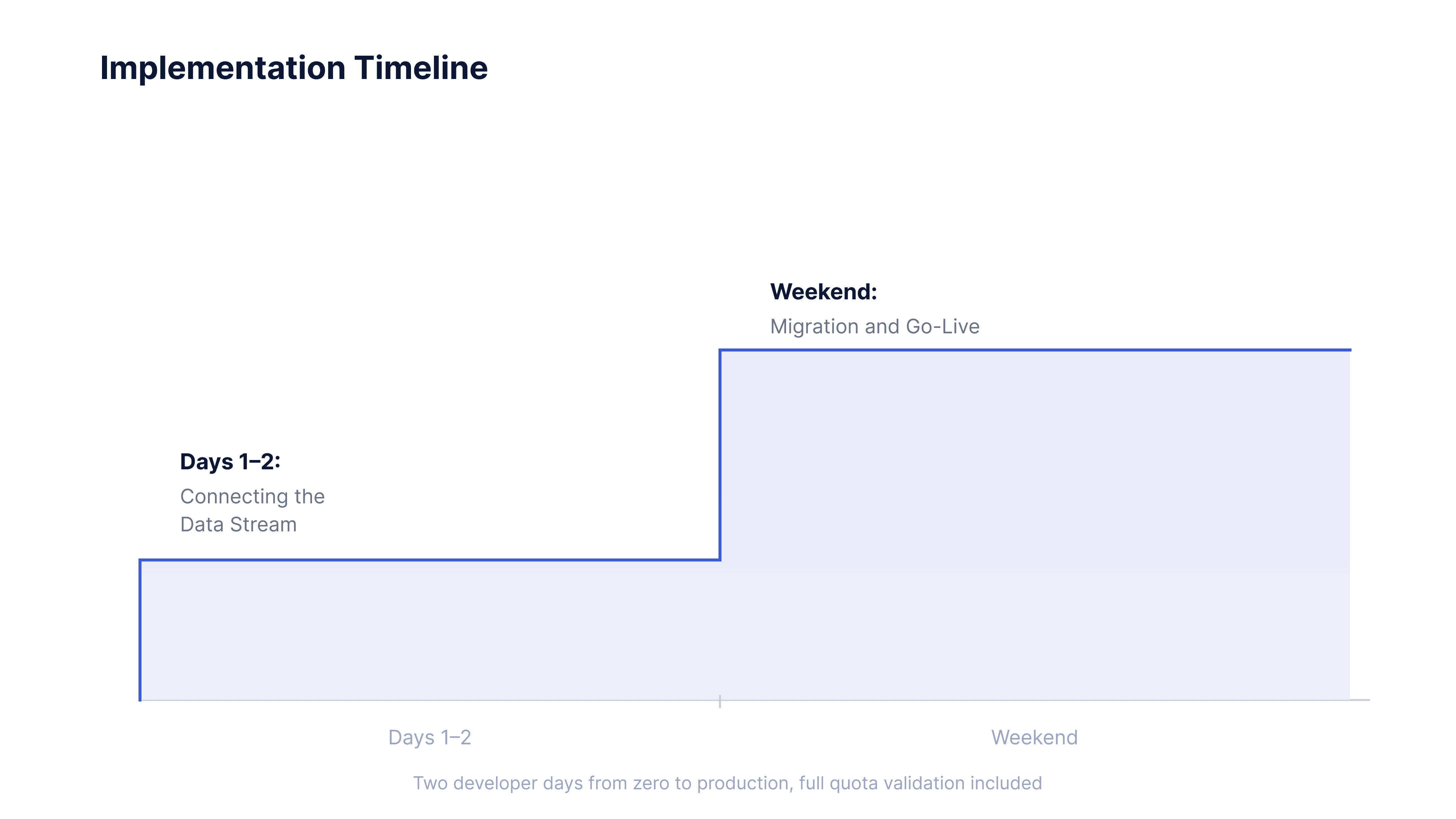
The Flexprice rollout was deliberately small in scope and fast in execution.
Two developer days from zero to production
Included full quota validation, not just event ingestion
Migration completed over a weekend, replacing the lagging dashboard before existing customers noticed
The Flexprice rollout was deliberately small in scope and fast in execution.
Two developer days from zero to production
Included full quota validation, not just event ingestion
Migration completed over a weekend, replacing the lagging dashboard before existing customers noticed
"It took me two days to set up Flexprice, including quota checks, not just sending events but also validating those events."
Real time entitlements and quota checks
Plan based entitlements with feature granularity
Customer facing usage event logs
Self-Serve Subscription Management
The Solution In Practise
The Solution In Practise
Today, CAS Parser uses Flexprice as the system of record for metering, entitlements, and subscription management.
1. Real time entitlements and quota checks
Every API request validates against Flexprice before serving. The backend calls Flexprice to confirm whether a customer is eligible to access a given resource. No local caching, no synchronization delays, no risk of overselling.
2. Plan based entitlements with feature granularity
Customer plans are modeled directly in Flexprice, with feature-level entitlements that control access at granular levels, including non-trivial plan structures like Unlimited tiers that were difficult to model cleanly in earlier systems.
"Switching subscriptions and entitlements, the granularity of features, and the developer event logs: those three things stand out the most."
3. Customer facing usage event logs
Flexprice surfaces every metered event in a way CAS Parser pipes directly to its customer dashboard. Customers see exactly what they consumed, when, and against which plan.
For an API platform, this kind of transparency is the foundation of trust, and it was completely missing under the previous setup.
4. Self-Serve Subscription Management
The most consequential downstream outcome. With clean APIs and real-time metering, CAS Parser built a self-serve billing flow that didn't exist before.
Today, smaller customers sign up, pick a plan, and start consuming credits without a sales touch. Sales conversations are now reserved for enterprise and contractual deals, exactly where they should be.
"It helps us reduce the time it takes to close new customers. Customers come in themselves, subscribe to plans, and it just magically works. There's no sales call. It moves us from sales-led to product-led."
Today, CAS Parser uses Flexprice as the system of record for metering, entitlements, and subscription management.
1. Real time entitlements and quota checks
Every API request validates against Flexprice before serving. The backend calls Flexprice to confirm whether a customer is eligible to access a given resource. No local caching, no synchronization delays, no risk of overselling.
2. Plan based entitlements with feature granularity
Customer plans are modeled directly in Flexprice, with feature-level entitlements that control access at granular levels, including non-trivial plan structures like Unlimited tiers that were difficult to model cleanly in earlier systems.
"Switching subscriptions and entitlements, the granularity of features, and the developer event logs: those three things stand out the most."
3. Customer facing usage event logs
Flexprice surfaces every metered event in a way CAS Parser pipes directly to its customer dashboard. Customers see exactly what they consumed, when, and against which plan.
For an API platform, this kind of transparency is the foundation of trust, and it was completely missing under the previous setup.
4. Self-Serve Subscription Management
The most consequential downstream outcome. With clean APIs and real-time metering, CAS Parser built a self-serve billing flow that didn't exist before.
Today, smaller customers sign up, pick a plan, and start consuming credits without a sales touch. Sales conversations are now reserved for enterprise and contractual deals, exactly where they should be.
"It helps us reduce the time it takes to close new customers. Customers come in themselves, subscribe to plans, and it just magically works. There's no sales call. It moves us from sales-led to product-led."
Migrating to Wallet-Based Billing
Keeping Payments Local, by Design
What's Next?
CAS Parser's roadmap with Flexprice has two clear threads.
Migrating to Wallet-Based Billing
CAS Parser currently uses Flexprice's plan-based entitlements model. The team plans to migrate to wallet-based billing, which offers more flexibility around credit accounting and prepaid balances. The Flexprice team has already advised on the migration path.
Keeping Payments Local, by Design
CAS Parser intentionally handles payments outside Flexprice. Because the product is focused on the home market, they use Razorpay and Cashfree directly, capture GST during the checkout flow, and don't need merchant-of-record functionality.
Flexprice serves as the metering, entitlements, and subscription layer; the payment rails remain local. The separation isn't a limitation. It's the right architectural fit for a product whose payment requirements are tied to a specific geography.
"If you're a SaaS building your monetization strategy, getting on board with Flexprice is something I would highly recommend. It changes the entire ballgame."
CAS Parser's roadmap with Flexprice has two clear threads.
Migrating to Wallet-Based Billing
CAS Parser currently uses Flexprice's plan-based entitlements model. The team plans to migrate to wallet-based billing, which offers more flexibility around credit accounting and prepaid balances. The Flexprice team has already advised on the migration path.
Keeping Payments Local, by Design
CAS Parser intentionally handles payments outside Flexprice. Because the product is focused on the home market, they use Razorpay and Cashfree directly, capture GST during the checkout flow, and don't need merchant-of-record functionality.
Flexprice serves as the metering, entitlements, and subscription layer; the payment rails remain local. The separation isn't a limitation. It's the right architectural fit for a product whose payment requirements are tied to a specific geography.
"If you're a SaaS building your monetization strategy, getting on board with Flexprice is something I would highly recommend. It changes the entire ballgame."
Migrating to Wallet-Based Billing
Keeping Payments Local, by Design
What's Next?
CAS Parser's roadmap with Flexprice has two clear threads.
Migrating to Wallet-Based Billing
CAS Parser currently uses Flexprice's plan-based entitlements model. The team plans to migrate to wallet-based billing, which offers more flexibility around credit accounting and prepaid balances. The Flexprice team has already advised on the migration path.
Keeping Payments Local, by Design
CAS Parser intentionally handles payments outside Flexprice. Because the product is focused on the home market, they use Razorpay and Cashfree directly, capture GST during the checkout flow, and don't need merchant-of-record functionality.
Flexprice serves as the metering, entitlements, and subscription layer; the payment rails remain local. The separation isn't a limitation. It's the right architectural fit for a product whose payment requirements are tied to a specific geography.
"If you're a SaaS building your monetization strategy, getting on board with Flexprice is something I would highly recommend. It changes the entire ballgame."
Ready to transform your billing infrastructure?
Ready to transform your billing infrastructure?
If you're spending valuable engineering time on billing instead of your core product or if you need to scale complex usage-based pricing without the overhead, Flexprice can help.
If you're spending valuable engineering time on billing instead of your core product or if you need to scale complex usage-based pricing without the overhead, Flexprice can help.
Schedule a Demo
Schedule a Demo
Talk to our team about your billing challenges
Talk to our team about your billing challenges
Start Building for Free
Start Building for Free
Get started with our open-source platform
Get started with our open-source platform
Read the Docs
Read the Docs
Explore our technical documentation
Explore our technical documentation
Join our Community
Join our Community
Connect with other teams solving similar challenges
Connect with other teams solving similar challenges